James HAYWARD
Works 1975-2013
September 12 - October 31, 2026
Reception Thursday, September 17, 6-8PM
-

Artworks by James Hayward
-

Abstract Diptych # 1
-

Absolute 55x46 Cobalt Violet
-

Homage to the Muse Cobalt Violet
-

Yellow Ratio #6
-

Absolute 21x16 Cerulean Blue
-

Fire, October 13, 1992
-

Automatic Painting 33x33 Black Gray White
-

Chromachord #110
-

ABSTRACT #17
-
--1788547876-SQR.jpg "ABSTRACT #190 (titanium white)")
ABSTRACT #190 (titanium white)
-

Morocco #18
-

Nothing's Perfect/The Second Proof
-

Morocco #30
-

Absolute 27x21 Manganese Violet
-

Automatic Painting 47x80 Black/White
-
--1788547648-SQR.jpg "ABSTRACT #184 (cadmium green)")
ABSTRACT #184 (cadmium green)
-

Flesh/Black
-
--1789623966-SQR.jpg "Sacred & Profane (16th var.)")
Sacred & Profane (16th var.)
-
_(Roma)--1789624816-SQR.jpg "Sacred & Profane (8th var.) (Roma)")
Sacred & Profane (8th var.) (Roma)
-
_(Roma)--1789625521-SQR.jpg "Sacred & Profane (15th var.) (Roma)")
Sacred & Profane (15th var.) (Roma)
-

Smoke #19
-

Smoke #123

Summary
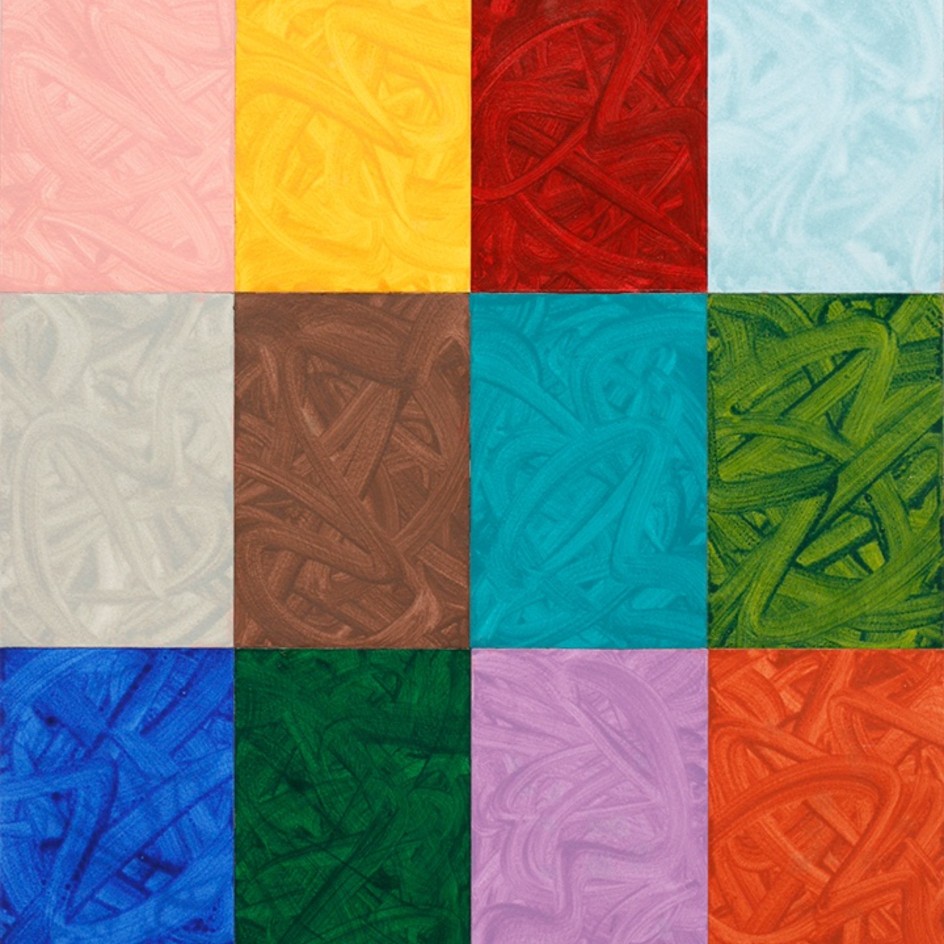
Modernism presents James HAYWARD: Works 1975-2013, the first survey of the artist’s work following his passing earlier this year. Bringing together paintings spanning nearly four decades, from the formal Automatic Paintings of the late 1970s to the densely worked monochromes of his mature practice, the exhibition examines Hayward’s sustained investigation of color, surface, gesture and the material possibilities of paint.
For more than fifty years, Hayward pursued the monochrome not as a restrictive format but as a field of inexhaustible variation. His earliest monochromatic works were deliberately restrained: flat, single-hued canvases in black, gray and dark green whose surfaces resisted evidence of the artist’s hand. The Automatic Paintings, begun in the 1970s, introduced repeated marks into these otherwise unified fields, allowing subtle variations to emerge through an intentionally systematic process. In 1977, Hayward was included in the landmark Less is More exhibition at Sidney Janis Gallery in New York, alongside artists including Josef Albers, Mark Rothko, Barnett Newman, Agnes Martin, Robert Ryman, Brice Marden, Yves Klein and Kazimir Malevich. The exhibition included examples from this formative period, among them Automatic Painting 33x33 Black Gray White (1975–79) and the monumental triptych Automatic Painting 47x80 Black/White (1977–79).
Working in Southern California, Hayward developed his practice in dialogue with the reductive tendencies of the Los Angeles art scene, including Minimalism and the L.A. Fetish Finish aesthetic. Yet where L.A. Fetish Finish prized immaculate surfaces, Hayward increasingly emphasized the physical presence of the artist’s hand, a distinction that became especially pronounced as his paintings grew more gestural and heavily impastoed.
A fellowship to Japan in 1982 proved transformative for Hayward, who became increasingly interested in the calligraphic mark and abandoned the anonymous surface of his earlier work in favor of a more physical encounter with paint. Oil, wax and increasingly substantial quantities of pigment accumulated across his supports, producing surfaces in which individual gestures remain visible within the mass of the painting. As Frances Colpitt writes in Modernism’s 2007 monograph on the artist, following the Automatic Paintings, Hayward turned toward “substantial gestural impasto.”
Writing on Hayward’s monochromes, critic Dave Hickey observed that “they are never exactly the same, nor could they be.” Their differences, he continued, are so delicate as to be “inexplicable and indescribable.” This insistence on difference within apparent sameness remained fundamental to Hayward’s practice, with repetition providing the conditions for continual variation. Jason Smith, writing in the same monograph, describes the artist’s process through Hayward’s own formulation: “The eye polices and the hand sets free.” The phrase encapsulates a tension that animated Hayward’s work for decades. However spontaneous the gesture, Hayward never relinquished formal rigor; however rigorous the structure, he allowed material and movement to disrupt it. In this way, the monochrome became an arena for both discipline and intuition.
The works gathered in James HAYWARD: Works 1975-2013 trace this pursuit from quiet optical fields to paintings whose surfaces project outward in dense accumulations of paint. Seen together, they reveal less a sequence of stylistic departures than the sustained elaboration of a single question: how much can happen within the ostensibly narrow boundaries of one color and one surface? As Frances Colpitt writes, Hayward’s paintings possess an “authoritative power and hypnotic grace,” yet “carry out a physical sense of contemplation.” For Hayward, the monochrome was not an endpoint but a structure capable of continual reinvention.
James Hayward [1943–2026] exhibited internationally throughout his career, with his work presented at and collected by institutions including the San Francisco Museum of Modern Art, Los Angeles County Museum of Art, the Hirshhorn Museum and Sculpture Garden, Washington, D.C. and the Institute of Contemporary Arts, London. In 2005, CUE Art Foundation in New York presented a solo exhibition of Hayward’s work curated by Mike Kelley. Modernism published the major monograph James Hayward in 2007, with essays by Dave Hickey, Frances Colpitt and Jason Smith.