overview
detail
zoom
grid
Eva LAKE
Relics of Beauty
February 12 - April 25, 2026 at MODERNISM WEST, 2534 Mission Street
Reception for the artist Thursday, February 12, 6-8PM
-
--1769899377-SQR.jpg "Etruscan No. 11 (Brunette)")
Etruscan No. 11 (Brunette)
-
--1769899432-SQR.jpg "Etruscan No. 10 (Rider)")
Etruscan No. 10 (Rider)
-
--1769899503-SQR.jpg "Etruscan No. 8 (Shell)")
Etruscan No. 8 (Shell)
-
--1769899589-SQR.jpg "Etruscan No. 4 (Eyes)")
Etruscan No. 4 (Eyes)
-
--1769899652-SQR.jpg "Etruscan No. 9 (Cosmetic Surgery)")
Etruscan No. 9 (Cosmetic Surgery)
-
--1769900181-SQR.jpg "Etruscan No. 7 (Drag)")
Etruscan No. 7 (Drag)
-
--1769900683-SQR.jpg "Etruscan No. 3 (Split)")
Etruscan No. 3 (Split)
-
--1769900881-SQR.jpg "Etruscan No. 6 (Boy)")
Etruscan No. 6 (Boy)
-
--1769900990-SQR.jpg "Etruscan No. 5 (Makeover)")
Etruscan No. 5 (Makeover)
-
--1769901055-SQR.jpg "Etruscan No. 2 (Red)")
Etruscan No. 2 (Red)
-
--1769901104-SQR.jpg "Etruscan No. 1 (Gold and Red)")
Etruscan No. 1 (Gold and Red)
-
--1769901156-SQR.jpg "Greek Sculpture Helmet (Democracy on My Mind)")
Greek Sculpture Helmet (Democracy on My Mind)
-
--1769901810-SQR.jpg "Some Girls No. 27 (Renaissance)")
Some Girls No. 27 (Renaissance)
-
--1769901369-SQR.jpg "Some Girls No. 22 (Skyscrapers)")
Some Girls No. 22 (Skyscrapers)
-
--1769901430-SQR.jpg "Some Girls No. 18 (Spanish Painters)")
Some Girls No. 18 (Spanish Painters)
-
--1769901692-SQR.jpg "Some Girls No. 17 (Greek Mosaic)")
Some Girls No. 17 (Greek Mosaic)
-
--1769901776-SQR.jpg "Some Girls No. 15 (Face Fragment)")
Some Girls No. 15 (Face Fragment)
-
--1769901903-SQR.jpg "Some Girls No. 13 (Indian Sculpture Lookbook)")
Some Girls No. 13 (Indian Sculpture Lookbook)
-
--1769902001-SQR.jpg "Some Girls No. 23 (Lipstick Formation)")
Some Girls No. 23 (Lipstick Formation)
--1769899377.jpg "Eva LAKE -- Etruscan No. 11 (Brunette)")
Summary
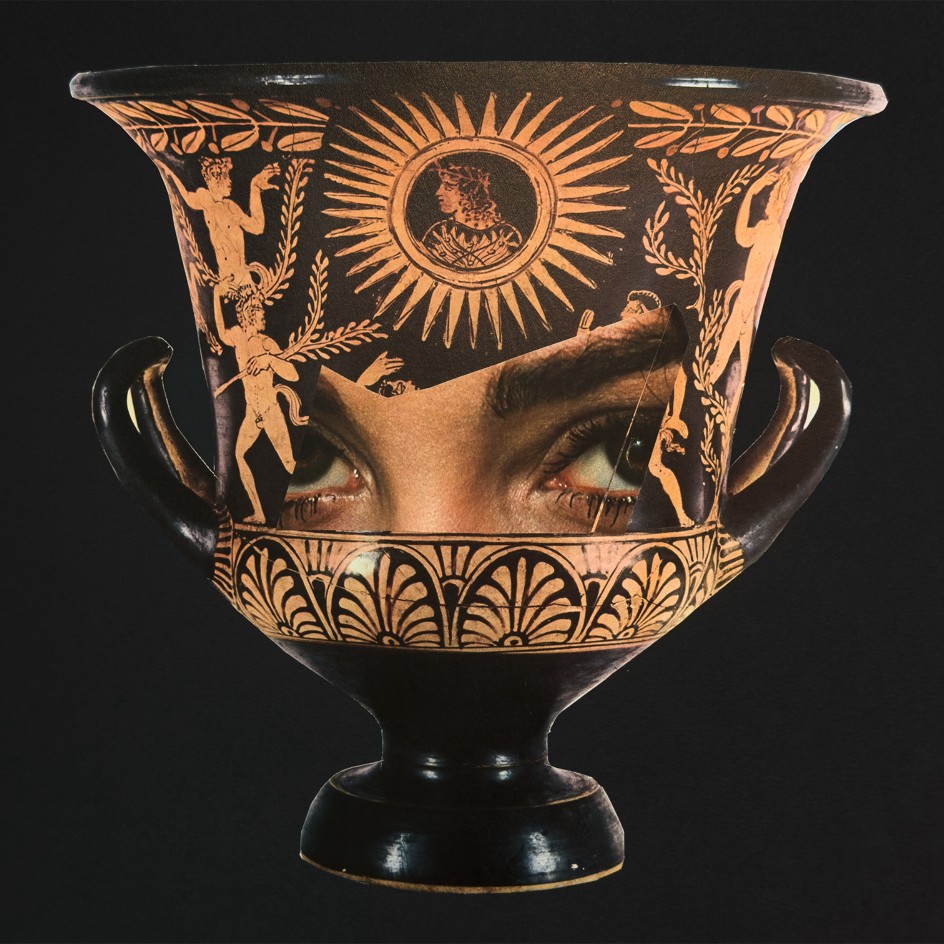
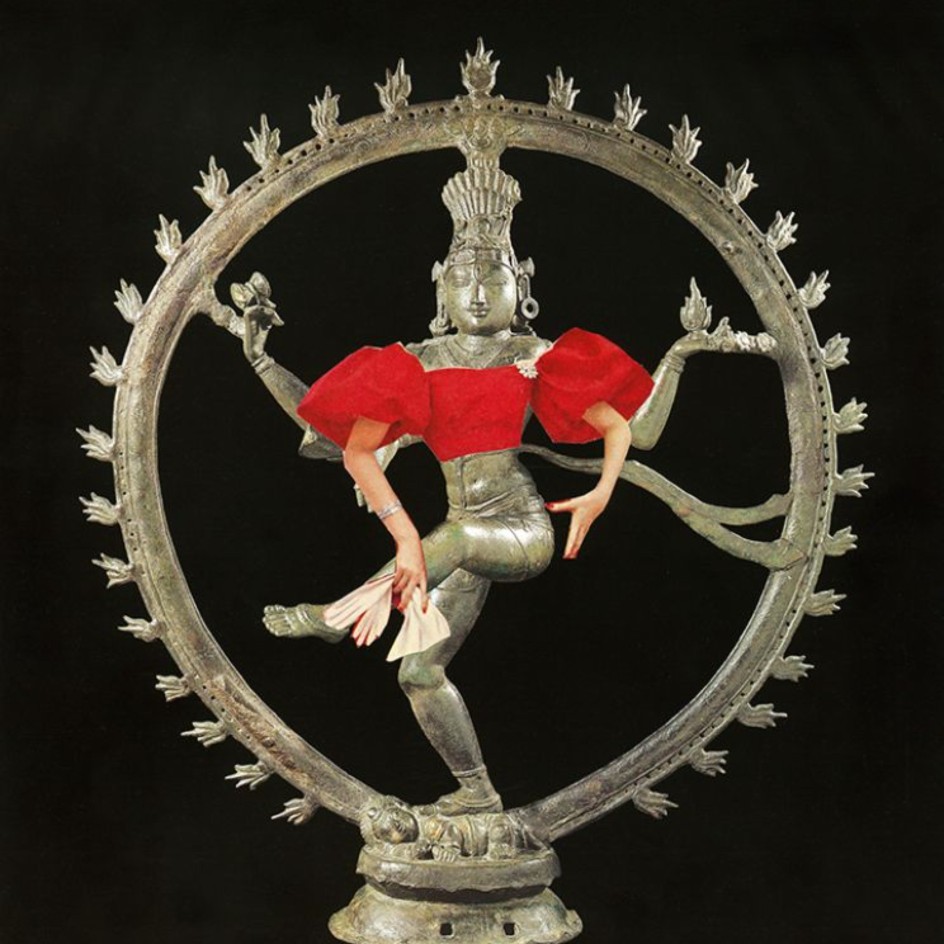
Modernism is pleased to present its second exhibition of collages by Eva Lake. In Relics of Beauty striking images are constructed from an array of art history and archeology photography paired with pop culture imagery of 20th century women. The result is a body of work that rewrites the historical record with softness and femininity and challenges the pervasive societal notions surrounding beauty.
Eva Lake’s collages are the natural culmination of her life and studies. She was a student of art history and archaeology at the University of Oregon and painting at the Art Students League of New York. Lake also spent decades working as a makeup artist and in the fashion industry. “In most of this work, I am uniting two lifelong pursuits: art history/archaeology and beauty/ fashion,” she says. “I want to mix up the narrative of who is grand and who is pedestrian, of what is worthy of endless theories, and of what is dismissed as pretty for the idle moment.”
In the spirit of Hannah Höch [1889-1978] who appropriated and recombined images from mass media to critique popular culture, Eva Lake’s collages are saturated with cultural criticism. Rooted in scholarship and composed of archival imagery from publications such as Gardner’s Art Through the Ages (1926) and The Metropolitan Museum’s Spanish Paintings: From El Greco to Goya (1928), Lake’s deep understanding of archival material allows her to produce a cutting cultural commentary that questions existing structures of power and sexism in the art world and beyond.
“When you look at ancient art, it's written about by men,” she says. “It was discovered and plundered by men. It was put into great museums like Berlin, Paris, London, and New York, by men. They are the ones that are documenting it, photographing it, and measuring it. And so I'm just trying to get in there. I'm trying to have the woman get a word in, edgewise,” explains Lake. “As always, I am trying to kind of feminize and do two things… I'm taking them down, and I'm bringing her up.”
This reclamation, or repatriation of sorts, is referenced in Lake’s collage Greek Sculpture Helmet (Democracy on My Mind). The woman, whose portrait was pulled from an Eastern European Cold War era magazine, is dressed in a helmet comprised of Elgin Marbles now held in the collection of the British Museum (a holding whose repatriation has been long debated). Lake takes the militant and softens it, but still returns to contemplation of morals and cultural injustice.
Another example of Lake’s encyclopedic art history knowledge at work is Some Girls No. 15 (Face Fragment), in which Lake references the partial face often seen in ancient sculpture. One of the Lake’s favorite pieces of art is the Egyptian Face Fragment at the Metropolitan Museum. “Perfect. And priceless,” she calls it. “I wanted to create my own tribute to the beauty and the power of faces I have known through the media,” she says.
On view for the first time as a collection are works from Lake’s Some Girls series. Lake recalls the origin of this work: A friend offered me a book on Egypt I already owned, cut into and had my fill of. I thanked him and turned down the gift. That night as I laid in bed, I asked myself, “Well, what could I do with it, a second time around?” I saw myself tearing out pages and creating a grid. That’s it! In this fashion I could build a large collage. As this grid floated in my evening mindscape, one that is generally psychedelic in palette, I inserted glamorous female faces into the sheets. My mind was just playing but I quickly realized that it was riffing in the vicinity of the Rolling Stones’ Some Girls LP cover (by Peter Corriston and Hubert Kretzschmar). I started this body of work with the same electric colors as the record cover, collecting paper in the same color range, photographing it and then having it printed. For the initial Some Girls, I began with Egypt but then ventured to other interests
In the pursuit of feminine reclamation of male dominated history, Lake takes the infamously reductive Some Girls album cover (the band joked it was named as such because they could not remember the names of the girls pictured) and imbues it with iconic women. This group of works is also notable as it is the first time Lake has used her own photographs in an analog collage, yet another layer of reclamation.
Similar to Dora Maar [1907-1997] who disrupted and reimagined the female form and face in her photomontage and painting, Surrealism is also ubiquitous in Lake’s reconstruction of the female image. The exhibition’s outlier Some Girls No. 23 (Lipstick Formation) reveals such influences. “I was lucky to collect five large lips from the same makeup ad, different magazines,” she recalls. “Same photo really, just different lipstick colors. Instead of cutting out the lipstick, I decided what the hell, I am a makeup artist. Let this kind of power rule the skies!” declares Lake. The suspended lips evoke the isomorphism of Man Ray’s The Lovers (1936) and the Soviet era blimp. “This work reveals the three movements which made the most impact on me as a young artist (Pop, Surrealism, and the Russian Avant Garde),” she continues. “Their precision and exuberance form the underlying foundation in almost everything I make—a hidden, buoyant order.”
Eva Lake has exhibited extensively in the United States and Europe since the 1980s. She is the recipient of multiple awards from the Oregon Arts Commission and the Ford Family foundation. Her work is included in the public collections such as the Museum of Modern Art, New York, and Portland’s Arts and Culture Council. She now lives and works in Portland, Oregon.
Press
Eva LAKE
Press Release - Eva Lake: Her Highness
2020-01-03